Evolving arpeggios: patterns that keep changing
A plain arpeggio gets old after four bars. The fix is not more notes but more cycles: rhythm, accent and tone that each repeat at their own length, so the pattern keeps shifting while the chord stays the same.
Why most arps sound static
A standard arpeggiator walks the held notes in one order at one rate, and every bar is a copy of the last. After a few passes your ear stops listening. Patterns that stay interesting usually stack several short cycles of different lengths: a 16-step rhythm against a 7-step accent only lines up again after 112 steps, which is seven bars of 1/16 notes.
Start with a Euclidean rhythm
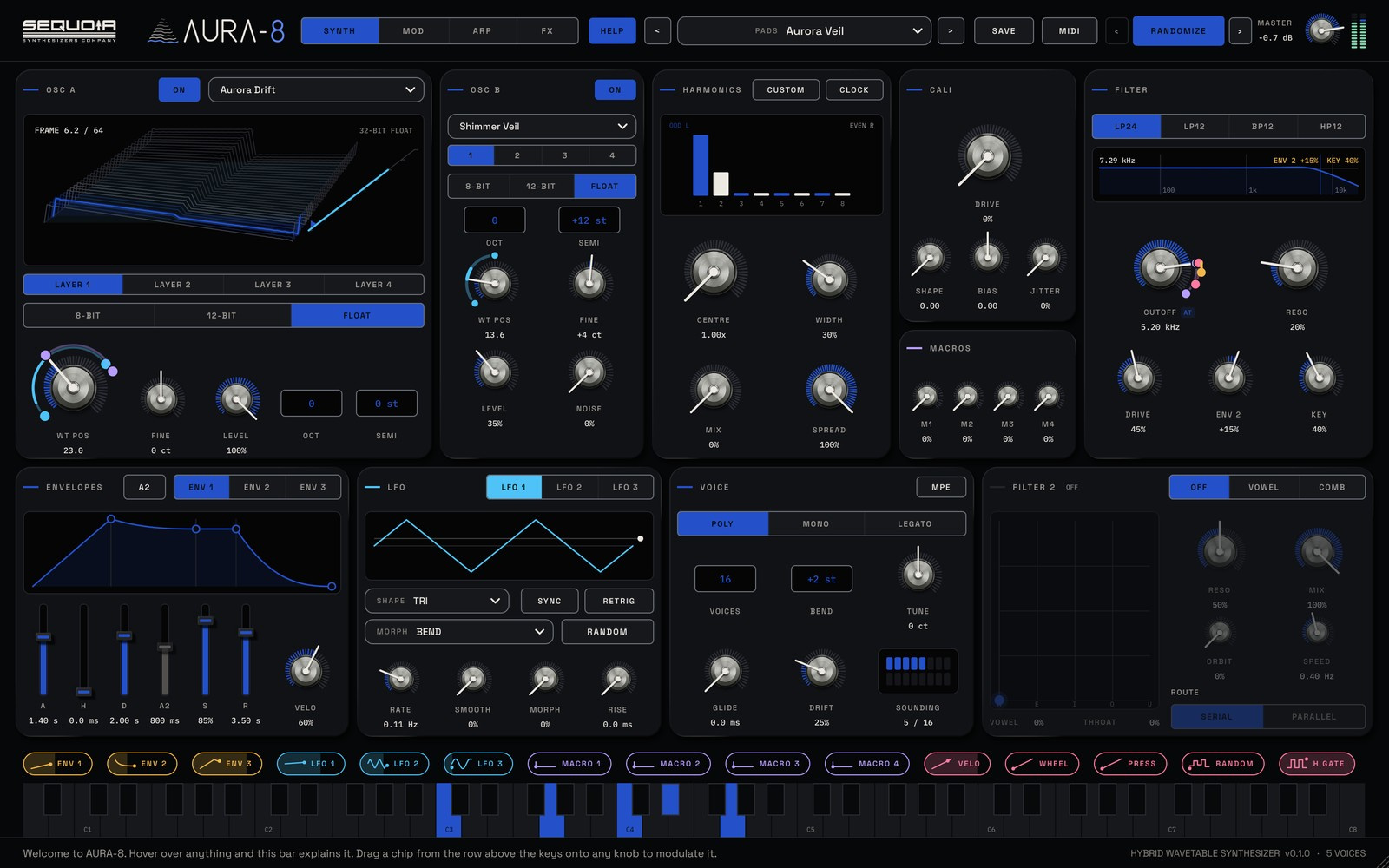
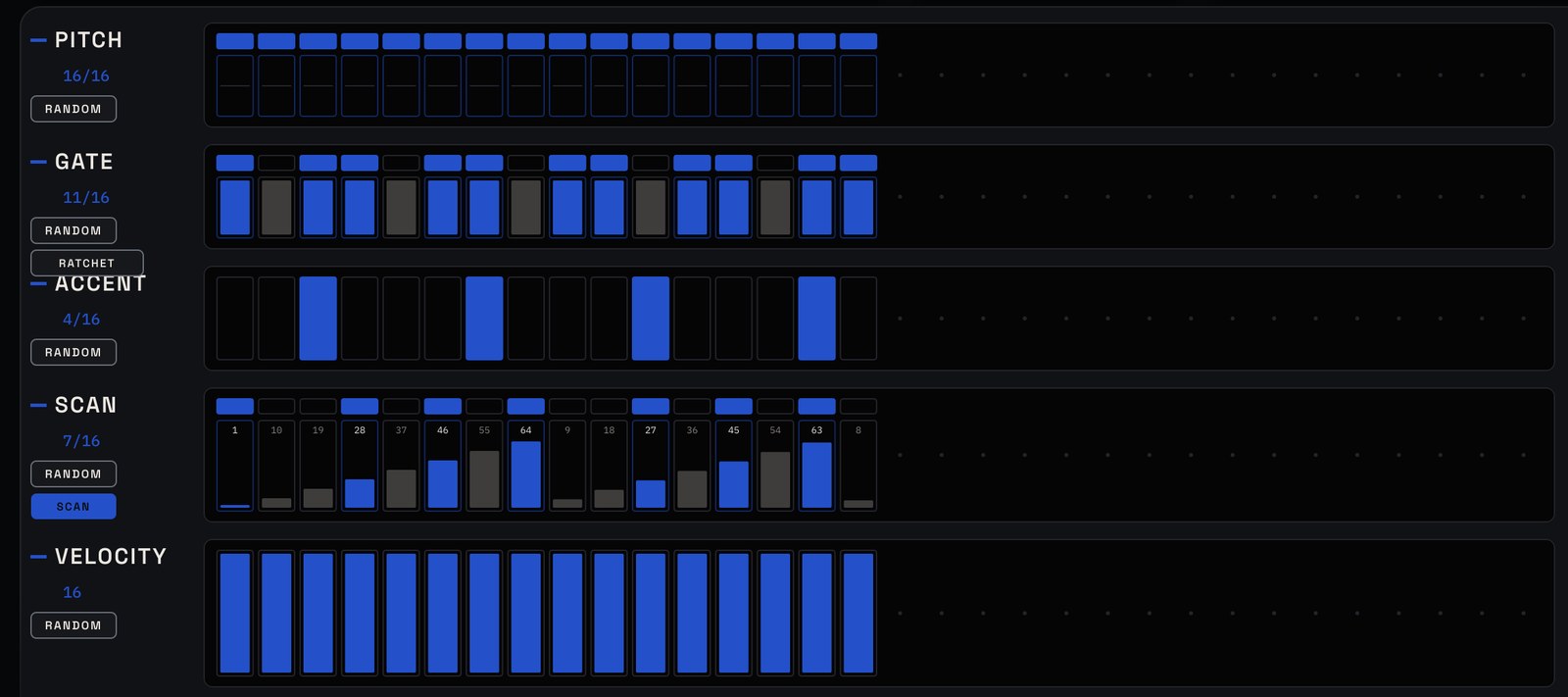
The Constellation arp in AURA-8 builds each lane from two numbers. STEPS sets the lane's length (1 to 32) and HITS spreads that many hits evenly across it. On the GATE lane, 16 steps with 11 hits gives a busy line whose five rests fall in musical places; 16 with 5 is sparse and syncopated. Click any step to switch it on or off by hand. A small dot marks your edits, and a right-click gives the step back to the pattern.
Give each lane its own length
The arp has five lanes: PITCH, GATE, ACCENT, SCAN and VELOCITY. Each one has its own STEPS, so they drift against each other. Leave GATE at 16, set ACCENT to 7 steps with 3 hits, and the accents land somewhere new every bar. RATE at the end of each row gives a lane its own clock as well: leave it on ARP to step with the notes, or choose 1/4 for a lane that moves more slowly.
Move the tone, not just the notes
The SCAN lane jumps up to three knobs on its hits. Slot 1 sets OSC A WT POS by default, so each hit lands on a different wavetable frame (1 to 64). Slots 2 and 3 push other knobs by an amount, for example FILTER 1 CUTOFF. Set SCAN to 5 steps with 2 hits and the timbre cycles on its own loop against the rhythm. ACCENT makes its steps louder and opens the filter; choose SOFT, MEDIUM or HARD with STRENGTH.
Add ratchets and ghost notes
Turn on RATCHET in the GATE lane and drag in up to six strikes per step for rolls and stutters. GHOST slips soft extra notes from the scale into rests and between steps, and G VELO sets how loud they are.
Stay in key
Pick a SCALE and ROOT and LOCK switches on, snapping every note the arp plays to the scale, including the PITCH lane's transpositions. On AUTO, AURA-8 listens to what it has been playing and works out the key itself; the panel header shows it, for example IN A MINOR.
A pattern to try
Start from Init and pick a soft TABLE (or make your own wavetable). Switch on ARP ON with ORDER Up, RATE 1/16, OCT 2 and a little SWING. Set GATE to 16 steps and 11 hits, ACCENT to 7 and 3, SCAN to 5 and 2 on WT POS, and GHOST low. Hold a minor seventh chord and let it run. If you lose your way, RESET ALL puts every lane back in step and BACK undoes it.
Questions
What is a Euclidean rhythm?
A pattern made by spreading a number of hits as evenly as possible over a number of steps. Three hits over eight steps gives the familiar 3-3-2 pulse heard all over dance music. In AURA-8, every arp lane takes STEPS and HITS, so each lane can carry its own Euclidean pattern.
How do I make an arpeggio less repetitive?
Give the lanes different lengths so they drift against each other, move the tone with the SCAN lane, and add a few ghost notes. A 16-step gate against a 7-step accent and a 5-step scan only lines up again after 35 bars of 1/16 notes.
Why is the arp silent when my song is stopped?
With LATCH off, the Constellation arp plays only while the song is playing. Turn LATCH on and it keeps running at the last tempo after you let go, then locks to the song again when you press play. In the standalone app, turn LATCH on to use the arp.